Brain Organoid Models for Antiviral Drug Screening

Technology Introduction:
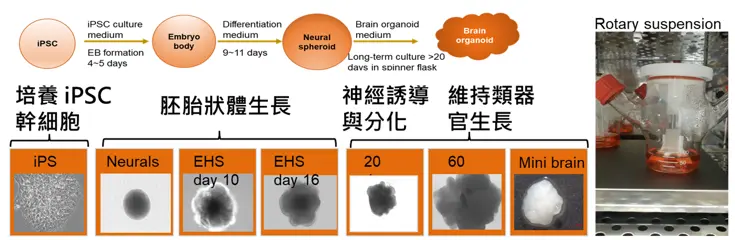
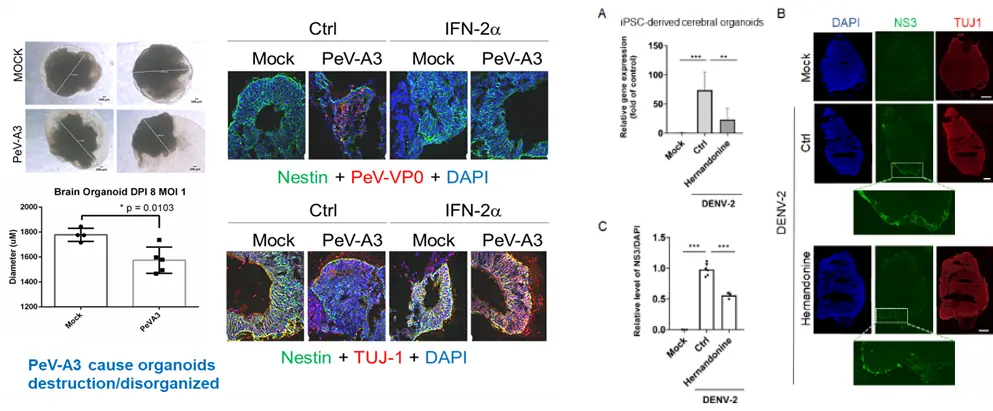
This invention uses human induced pluripotent stem cells (iPSC)–derived organoids as a development platform for anti-encephalitis virus drugs. Human organoids replicate the three-dimensional structure and diverse cellular composition of real organs, providing a closer approximation to the physiological environment. This study successfully demonstrates that brain organoids can be infected by neurotropic viruses, and that treatment with interferons and antiviral drugs effectively suppresses viral infection, highlighting their high potential as a platform for antiviral drug screening.
Industrial Applications:
Centered on human 3D brain organoids derived from iPSCs, this technology offers diverse development potential. It can be applied to antiviral drug screening, enhancing clinical relevance while reducing animal usage, and extended to neurological disease modeling to simulate pathologies such as encephalitis, neurodegeneration, or gut-brain axis disorders. In the realm of precision medicine, it enables the generation of patient-specific organoids for personalized drug response testing; additionally, it serves as a vital tool for early-stage drug development by facilitating toxicology and safety assessments. Characterized by high reproducibility and scalability, the platform holds significant value for commercialization and industrial translation.
National Defense Medical University
Founded ten years prior to the establishment of the Republic of China, this institution holds the distinction of being the oldest military academy of its kind in the country. Its predecessor was the Army Medical College. On June 1, 1947, the college merged with thirteen other units—including the Wartime Medical Personnel Training Center and its various branches and sub-centers—to form the National Defense Medical Center (NDMC) in Jiangwan, Shanghai, operating under a medical center model. In 1949, the institution relocated to the Shuiyuandi area of Taipei alongside the government. On July 1, 1983, the Tri-Service General Hospital—already serving as a teaching hospital—was formally integrated as the institution's directly affiliated teaching hospital, thereby strengthening the integration of its educational structure. To meet the evolving needs of national defense medicine and the demands of the times, the institution established doctoral and master's degree programs as well as specialized medical service training courses; these initiatives aimed to cultivate senior faculty and research talent while bolstering the ranks of frontline medical personnel. Following the completion of the "National Defense Medical Center Redevelopment Project" in late 1999, the institution relocated to its current site in Neihu. On August 1, 2025, it was reorganized as the "National Defense Medical University."
Contact Information
Name:Tsung-Hsien Chang
Tel:0929-111-639
Address:No.161, Minquan E. Rd., Sec. 6, Neihu, Taipei, 11490, Taiwan
Patents:
I861777